Join My Mailing List

Join my mailing list for the latest stories, offers, and updates!!

Friday, January 27, 2017

Beyond the Well of Ignorance


At the first Parliament of the World’s Religions, Swami Vivekananda had said the following lines:
“I am a Hindu. I am sitting in my own little well and thinking that the whole world is my little well. The Christians sit in their little well and think the whole world is their well. The Muslims sit in their little well and think that is the whole world.”

Nothing demonstrates the above lines better than the sudden and irrational surge of jingoistic nationalism that seemed to engulf our Foreign Minister, and by extension the country at large, when it became known that Amazon was selling doormats with the Indian tricolor printed on them through its North American e-stores. The entire nation went into a kind of hyper-nationalistic frenzy, with the Foreign Minister going so far as to threaten the deportation of all foreign Amazon officials in India, should the doormats not be immediately withdrawn from their website.

The problem with this reaction, however, is that the correlation of feet with something unclean or disrespectful is a uniquely Indian (and specifically Hindu) concept. Hence we touch the feet of our elders as a mark of respect, and avoid touching valuable things like books or money with our feet. To point at or touch someone or something with one’s foot would be considered a mark of disrespect in the Indian context.

However, like the fool sitting in his well in Swami Vivekananda’s speech, we fail to take into account that this association of feet with disrespect might not hold true in other countries, or for people belonging to other cultures. Along with doormats sporting the colours of the Indian flag, Amazon also sells doormats and carpets painted in the colours of several other national flags, as well as various kinds of religious symbols like a Christian cross or the Jewish Star of David. For people of other countries, having their national flags displayed on their doormats is a matter of pride, as it is the first thing a visitor sees of the house, even before entering, and it is a visible sign of the resident’s devotion to his own country.

In attributing our own cultural preconceptions about the significance of feet – and by extension doormats – to people who do not share that culture and have no reason to abide by our cultural values, Sushma Swaraj, and Indians by extension, have displayed the same narrow-minded blindness that Swami Vivekananda had warned us about. To stand as a great nation on the world stage, the youth of India must learn to climb out of the jingoistic well of ignorance the politicians have dragged them into, and perceive the vast cosmos that lies beyond.

Thursday, September 1, 2016

Deceptive Marketing or Criminal Fame – A Study in Social Hypocrisy.


Following the suggestions of a Parliamentary Standing Committee, the Central Government is preparing to bring into existence a new law that would make celebrities and other media personalities accountable for endorsing products or services in ways that might be considered misleading or deceptive from the point of view of the consumer.

A fine of upto ₹10 lakh along with a prison sentence of two years may be levied upon a first time offender, while repeat offenders may be handed a fine of upto ₹50 lakh along with a prison sentence of five years or above.

While I can understand why many people would find the existence of such a legal provision reassuring, I cannot personally support the implementation of such a law, should it ultimately come into existence.

The reasons for my objection to such a law are varied and numerous, but I will try to explain all of them in the following paragraphs.

To punish a celebrity for the misleading advertisements conceptualized and created by companies and other corporate entities is the same as punishing the agents of a fraudulent financial firm for the activities of their employers. I am sure there will be many who would be unable to relate to this argument. After all, when we think of smalltime financial agents we imagine a harried-looking sales person knocking on our door at inconvenient hours, probably someone hailing from a relatively underprivileged background with limited opportunities for employment. The word ‘celebrity’, however, immediately brings to our mind images of couture clothing and branded jewellery, perfectly made up faces and styled hair. How can the two of them possibly be compared to one another?

But when we really come to think about it, we realize that there really is not that much of a difference between the two when it comes to knowledge and understanding of the technical details of the product they are selling. A celebrity is as incapable of understanding the nuances of the chemical formula used in the fairness cream she is endorsing as a financially illiterate agent is of comprehending the intricate monetary details of his company. Should the company’s monetary policy be faulty, is the agent not innocent of that deception? If so, then how can the celebrity endorsing the fairness cream be expected to know if the formula for the product contained irregularities?

The greatest charge that can be brought against them is one of carelessness; but surely one should not be locked up in a cell for years for that crime alone.

This brings me to my second point. It is human nature to be interested in the rise and fall of celebrities. The rapidly proliferating gossip sites and tabloids stand witness to the fact that we are endlessly fascinated by the lives of celebrities; by their successes, but even more so by their failures. It is in our nature to deify those we admire, only to then watch their pedestal break.

It is easy to dissociate ourselves from the troubles of those with whom we cannot relate. They are celebrities, after all. They have it all! Money, fame, popularity, beauty – more than we could ever dream of having. What problems could they ever face?

Tempting as it is to assume that self-righteous position, we must remember that deifying a man does not really grant him divine powers. Celebrities can be as easily deceived as a common man. They are as prone to making mistakes. And being famous does not make their mistakes any more or less culpable than ours. Just as a common man may be deceived by a celebrity’s endorsement of a sub-par product, so too can a celebrity be deceived by the agents of a company into believing that the product is of better quality than it actually is.

Expecting a celebrity to actually use every single product that he or she endorses is an unreasonable demand. It is the same as expecting an insurance agent to have personally subscribed to every single insurance policy that he is selling. Even if the celebrity actually wanted to do so, there would not be enough time to analyze the long-term effects of using the product before the advertisement was made. Also, the company could provide the concerned celebrity with a better specimen of the product than the one being sold in the mass market. Now of course, the celebrity could probably go in disguise to a local market and anonymously buy the product in order to then use it and authenticate the claims of the company, but I think we can all understand the impracticality of such a practice, especially when carried out on an industry-wide scale.

Consumers are not children, and should not be treated as such. When Akshay Kumar jumps off a cliff to catch a bottle of Thums Up, I do think that all well-balanced adults know to take his actions with a grain of salt. Why then should we not receive Parineeti Chopra’s weight-loss claims with similar skepticism? In the age of the internet, it is impossible to completely shield our citizens from dubious information about a variety of things. Why not then truly train them to distinguish between reality and exaggeration, instead of trying to implement ambiguous and impractical laws against entertainers who may have no idea about the misinformation being spread in their names?

It is time for us, as a nation, to grow up and accept responsibility for our own actions; to banish the gullibility that advertisers use to lure us with the faces of film stars superimposed upon useless products. If somebody must be punished, it is the companies that knowingly disseminate false information for personal profit. Imprisoning innocents – no matter how enviable their position – for our own lack of sound judgment is not justice, it is just another form of the same misdirection and obfuscation of which we are accusing the celebrities. 

Saturday, August 27, 2016

An Objective Study in the Subjectivity of Sherlock Holmes.

To say that Sherlock Holmes – as portrayed by the delectable Benedict Cumberbatch in BBC’s hit show ‘Sherlock’ – does not feel emotions would be to do an egregious disservice to the character. This is a man who literally shoots the walls when bored, wanders about the Buckingham Palace buck naked just to spite his brother and, in The Reichenbach Fall, dramatically falls off a building to impress his friend Dr. Watson. Sherlock is anything but unemotional. What he is, is improperly emotional. He feels emotions fine, just not the ones he’s supposed to feel at any given point of time.

Yet, why is it that all of us at one time or another have connected the word emotionless’ to Sherlock Holmes? Why do so many of us harbor the misconception that Mr. Holmes, perhaps the most emotionally volatile of all the show’s numerous characters, is a cold, unfeeling sociopath? We think it, not because that is what Sherlock really is, but because that is what he wants to be; how he wants the world to see him.

The question then, is why?

And the answer is pretty simple, really. 

It is not Sherlock, but Mycroft who is Irene Adler’s Iceman. It is Mycroft who is the unemotional one, at least when it comes to everything but his little brother Sherlock.

And it is big brother Mycroft who has taught Sherlock everything he knows. It is from Mycroft that Sherlock had learned the art of deduction, one of the most integral parts of his personality; Mycroft who appears as the judge and jury of his mind palace. Is it any surprise, then, that it is Mycroft’s idea of a perfect mind that Sherlock is trying so desperately to emulate, consciously or otherwise? It is not Sherlock but Mycroft who had always considered emotions to be a superfluous weakness, and for the longest time Sherlock had believed his big brother with the blind faith of a child.

It was only the advent of the proudly sentimental Dr. Watson in his life that had made Sherlock question that deeply ingrained notion for the first time. Still, old habits die hard and it will take a few seasons yet for Sherlock to come to see his emotions for what they really are: an asset to be harnessed to its full potential, rather than a liability that needs to be suppressed and denied.


Fear not, though. There is hope yet. The Season 3 episode ‘The Sign of Three’ gave us this gem of a conversation between Mycroft and Sherlock –


MYCROFT: Well, it’s the end of an era, isn’t it? John and Mary – domestic bliss.
SHERLOCK: No, no, no – I prefer to think of it as the beginning of a new chapter.
Mycroft smiles.
SHERLOCK: What?
MYCROFT: Nothing!
SHERLOCK: I know that silence. What?
MYCROFT: Well, I’d better let you get back to it. You have a big speech, or something, don’t you?
SHERLOCK: What?
MYCROFT: Cake, karaoke ... mingling.
SHERLOCK (angrily): Mycroft!
MYCROFT: This is what people do, Sherlock – they get married. I warned you: don’t get involved.
SHERLOCK: Involved? I’m not involved.
MYCROFT: No.
SHERLOCK: John asked me to be his best man. How could I say no?
MYCROFT: Absolutely!
SHERLOCK: I’m not involved!
MYCROFT: I believe you! Really, I do! Have a lovely day, and do give the happy couple my best.
SHERLOCK: I will.
MYCROFT: Oh, by the way, Sherlock – do you remember Redbeard?
SHERLOCK (angrily): I’m not a child any more, Mycroft.
MYCROFT: No, of course you’re not. Enjoy not getting involved, Sherlock.

Loathe as he is to admit the fact, clearly Sherlock is involved, very much so. Mycroft sees it, and subconsciously so does Sherlock, though the indoctrination will take some time to wear off yet. But as Sherlock tells his brother, ‘he is not a child anymore’, and sooner or later he must emerge from under big brother’s protective psychological wings and spread his own.

Objectivity might well be Mycroft’s weapon of choice, but as Sherlock’s psychological warfare with Moriarty has proven again and again, subjectivity too can be its own kind of lethal ammunition. It takes fire to fight fire, after all, and dry logic in itself could never have defeated a mind such as Moriarty’s. It was Sherlock’s understanding of Irene’s love for him that did what Mycroft couldn’t, and saved the day – and the country – in ‘A Scandal in Belgravia’, beating the consulting criminal’s painstakingly woven plan. Sherlock, whose instinctive, sentimental protectiveness for Watson and his family put an end to the evil that was Magnussen.

Perhaps, then, the day is not far when Lestrade’s prediction will come true – and Sherlock Holmes will be not only a great man, but a good one too!

Tuesday, August 16, 2016

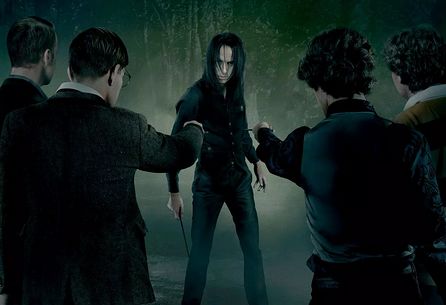
Harry Potter – The Damned Generation.

One of the most talked about topics within the Harry Potter fandom relates to the matter of the so-called 'Marauders' - to Moony, Wormtail, Padfoot and Prongs. The four of them together - perhaps better than any other character in the novels - represent what may be called the damned generation of Hogwarts.

Remus Lupin, Peter Pettigrew, Sirius Black and James Potter, along with their various friends, enemies, contemporaries and associates, all had one thing in common. Can you guess what it was? Yep, I think you can-

They all had their lives destroyed in one way or another by the rise of Lord Voldemort. Some chose the destruction, and moved willingly into its fold. Others resisted it with all they had. But it was a force that engulfed them all - that eviscerated not one man but an entire generation, leaving nothing but the ashes of memory and regret in its wake.

Perhaps the most iconic, if controversial torch-bearer of that generation was Severus Snape; a man both loved and reviled with equal passion within the fandom. And perhaps fittingly, he represented to a great extent the essesntial quality of his generation, a stark juxtaposition of virtue and vice, of darkness and light. The opposite of a Voldemort or a Harry, the damned generation flourished in shades of grey.


Even Peter Pettigrew, perhaps the damndest of the damned, managed to redeem himself in his final moments by sacrificing his life to save Harry, unable to kill him during the skirmish at Malfoy Manor. If not an act of bravery - it is debatable if Wormtail was even capable of such a thing - it did show us a momentary flash of what was left of his humanity, of the silly little boy whom the Marauders had brefriended, and by whose ultimate betrayal they had fallen.

Even the other Marauders, despite the haloed position accorded to them by fandom, were wrapped from head to toe in shades of grey. Heated debates and arguments between supporters of James, Sirius and Snape have already overwhelmed the internet, so I won't bore you with that again. But their cruelty to young Severus, even if born of mere immaturity, cannot be denied - especially when contrasted against Harry's instinctive empathy for Neville Longbottom, a pathetic, sickly young man in much the same situation as Snape a few decades ago.

Yet that is perhaps what contributes most to the appeal of that generation - the unfulfilled potential, both for great good and for great evil. James' ultimate sacrifice for his family, Lily's unconditional love for her son, Sirius' unwavering loyalty to his friends and Lupin's extraordinary courage even in the face of insurmountable odds, these are the qualities that draw us to them with a magnetic force, even when we can see the doom that awaits them all. Severus, despite the petty bullying to which he subjected his unsuspecting students, died a hero, perhaps greater than all the rest put together; having saved more lives through his spying than any other member of the Order of the Phoenix. Yet his motives remained, to the end, less than noble, with him going so far as to admit to Dumbledore that he protected Harry not out of any regard for the boy himself, but only because of the obsession he still harboured for the late Lily Evans.

Prerhaps, to a great extent, that generation damned itself. The brightest lights, after all, cast the darkest shadows - and it was perhaps their brilliance that drew the darkness of Lord Voldemort upon them, shining like beacons in the dullness of unremarkable mediocrity. Whatever the reason for their rise, or the cause of their untimely fall, they will remain the brightest stars in the HP fandom's vast firmament - the ones that burned the brightest in falling. 

Wednesday, July 13, 2016

Leaving Home – A Brand New Journey.

“We are perpetually torn between nostalgia for the familiar and an urge for the foreign and the strange. As often as not, we are homesick most for the places we have never known.”
― Carson McCullers

I’m sorry for the very late update, guys. Unfortunately, for the past few weeks I’ve barely had the time to catch any sleep, much less write anything.

So here’s the big news. I’m now a newly minted graduate, and all set to start my new life at university!

But things aren’t just excitement and fun. In fact, at the moment, they’re quite the opposite. Why, you ask? Because government universities in India appear to bear a terrible grudge against punctuality. Well, most of them anyway. Some of them have been thoroughly punctual, but unfortunately those were the exceptions. The rest seem to be of the opinion that declaring the results of entrance exams is only a little less important than watching tumbly-puppy videos on YouTube.

But the thing is, while I still don’t know for sure which of the several fantastic universities across the length and breadth of this beautiful country I will finally end up in, I know one thing for certain. It ain't gonna be one in my city.

Now don’t get me wrong here. I LOVE my city. I love its roads and its (sometimes ramshackle) buses and its cafes and malls and parks. I love the phuchka stalls at every street-corner and the jhalmuri uncles on the local trains. I’ve had the time of my life here, in the nooks and crannies of this gorgeous town! There is absolutely nothing about it I won’t miss. Well, maybe the traffic. Probably won’t miss that too much; but then, that’s neither here nor there.


Now you might be asking the question, if you loved it so much, why leave? 

It certainly isn’t that there aren’t any good universities in Kolkata. There are, and very good ones at that. Many of my friends have decided to remain here to pursue their post graduate studies, while many others left right after school. Personally, I made no attempt to leave home after school, didn’t even apply to any colleges outside Kolkata. And you know what? I’m glad I didn’t. I wasn’t ready yet. Hell, I barely know if I’m ready now.

But I always knew that at some point or the other, I would leave. And if I don’t do it now, I don’t think I ever will. Familiarity is addictive, nice warm and comfortable, like a soft worn blanket on your shoulders. It’s not something you wanna get rid of if you can possibly help it, no matter how frayed it’s gotten. Well, at least I don’t.

But sooner or later, it must be done. Not for lack of love for the familiar. As I said, I have loved every moment of my life in Kolkata. But there’s more to the world than home. Hell, when you think about it, in the vast stretches of empty space that is our universe, the entire world is home! A tiny oasis of familiarity and comfort in a scary sea of the unknown.

And it is scary, to wade out into the unfamiliar, unknown waters of that sea all on my own, leaving everything I know behind. I don’t know how I’ll fare, whether I’ll sink or swim in the new waters.

But that’s the point! I have to find out for myself! I need to know what’s out there, what the world looks like from the windows of a room not my own. In a strange way, I feel as if I have to leave my comfort zone to learn to be comfortable in my own skin. I don’t even know if that makes any sense, but somehow, it feels important to me.

Perhaps it is just another rite of passage that I have to overcome before I can really call myself an adult – not just chronologically, but in all the ways that really matter. I know I’ll be homesick, probably even pretty depressed for the first few weeks. Hell, I’m missing my friends already, not to mention my home and family. But maybe, hopefully, I’ll also learn some new things while I’m at it, meet new people and gain some new experiences that would have eluded me in the comfort of my home.

And the best part? Through all of it, through all the excitement and the heartache, the adventures and the nostalgia, I’ll always have a home to call my own, a place to return to when the outside world gets to be too much. 

I’ll always have my city, my Kolkata!!! :)

Saturday, June 18, 2016

Language, Identity & Intellect – Finding Connections Where None Exist?

Hi guys!

So today I wanna talk about language – and the things we consciously or subconsciously associate with that uniquely human mode of communication. Language is human, because no other species on Earth, as far as our knowledge is concerned, have or use languages. The writing, reading and speaking of thoughts in the form of words and syllables is a uniquely human phenomenon.

So is language something we get by virtue of being human – like a gift or a prize? Or is it, in fact, a condition for humanity itself? A part of what makes us human?

Or are all these questions a pointless waste of time, finding symbolism and deeper meanings where none exist?

I was born and raised in India, having spent most of my life in the city of Kolkata, to be precise. So I’m going to draw mostly on my experiences from this background, as those are the only experiences I have to draw on. I don’t know if what I’m about to say holds true for the rest of the world, perhaps it does not, but bear with me anyway. ‘Cause this is not so much a discussion on one particular country or culture, but rather a dissection of human response to our ideas of country and culture.

So just for a little background here, for those of you who might not be so familiar with this matter, India is basically a country made out of multiple regions or provinces, each of which have their own language, customs, clothing, etc. It’s basically a tropical Europe, with one constitution. Each state of India has a state language, the whole country has Hindi for its national language (as that is the Mother tongue of most people residing here), and English is just that awkward houseguest that was originally supposed to be a temporary visitor, but ended up just hanging on through it all anyway. The reason it did that, among other things, was because India just has so many languages that nobody could really agree on which of the native languages should reign supreme over the others. After all, nobody likes being considered second-best. So English it was then, the awkward foreigner nobody thought to compete with in the first place, and that’s where we are now!

How many languages you learn as a resident of India, depends not so much on your talent or interest in linguistics as on where and to whom you were born in the country. Now suppose you were born in a Hindi-speaking state to native, Hindi-speaking parents. Well, lucky you! The only languages you need to learn are Hindi – the national language that also doubles as your mother tongue – and English, the international language you’ll probably need to read articles on the internet.

Now suppose you’re like me. You live in a non-Hindi speaking state, with non Hindi speaking parents native to that state. Like I live in the capital of Bengal, and happen to have been born to Bengali parents. Well, things aren’t so bad then. You just compulsorily have to learn three languages – Hindi, the national language; English the international one and whatever your state language happens to be, which also doubles as your mother tongue. Hurray!! The same goes for native Hindi-speakers living in non-Hindi speaking states, as their mother-tongue also moonlights as the national language; they’ve already got that one covered.

Don’t get too happy yet, though. What happens if your parents are non-Hindi speakers, living in a state that is not their native one and also not a Hindi-speaking state?

Well, my friend. To put it simply, you’re fucked. Now you have to learn the international language, the national language, the state language and your mother tongue, all by the time you’re five years old. Because if you can’t manage that? You’re either an idiot or a self-hating traitor, or wait for it – BOTH!

And if you value your own sanity you better pray to God that your parents didn’t get adventurous and marry outside their own linguistic community because then, why even bother? You might just as well denounce society and walk off into the Sahara desert already.

But what happens if you just learn the one (or maybe two) languages you like the best and leave it at that, you might ask? Why not learn just the ones you actually need to use in your day-to-day life?

Well, that’s what this discussion is all about.


Because apparently, if you can’t speak, write and read English like a pro, you’re just a village idiot with no brains and no future. It doesn’t matter if you’re a doctor treating poor, sick people in remote areas of the country who’d never have to utter a syllable of English in his entire life if he doesn’t want to. Don’t know English? Yep, an absolute moron.

But let’s say you can speak beautiful English, and just that. Let’s say your parents were diplomats travelling the globe and you never had occasion to learn multiple languages you’d never have to use anyway. Or maybe you’ve spent your entire life in the more remote parts of one of the aforementioned non-Hindi speaking states, and never had occasion or reason to learn the national language. Don’t know Hindi? How dare you call yourself an Indian?! You’re obviously ashamed of your own country’s rich heritage, which apparently includes mandatory knowledge of a language half the population doesn’t speak. You’re a self-hating pseudo-American loser, and that’s that!

Alright then! Hindi and English it is. You’ve learnt both. Can we have some peace now? Well, apparently not. Because how dare you focus on the national and international languages without paying equal attention to your own mother tongue? Never mind that you live in a place where nobody but your dad speaks that tongue. How dare you?!! Arrogant, self-hating, insecure traitor of a ten-year-old, you!!

Okay okay we get it! We’ll learn all three. Happy now?

Nopety nope! Not so fast, buddy.

What about the state-language? You know, the language of that state you’re only living in because your parents have been transferred there for a couple of years, the one you’ll be out of in a little over 700 days and never have occasion to speak the language of again? Yep, if you wanna go to school there, you gotta learn that. Even though everyone in that state already knows at least one of the other languages that you speak, so there’s no communication gap during your short stay to speak of, and once you’re out of that state you’ll never ever need to speak that language again anyway. But not only do you need to learn how to speak it, you also need to learn how to fluently read and write it too. Many states have made it mandatory for schools within their borders to teach their own language to all students enrolled therein, regardless of the preferences or necessities of the students themselves.

Lucky you. Or not.

So why exactly do we as a nation have such a schizophrenic attitude towards languages? What is it that we really even want?

I am not saying that learning new and diverse languages is a bad thing. Quite the opposite, actually. Honestly, to me, there’s nothing cooler than a person who can speak, read and write multiple languages fluently. And there are some children that have a natural facility for learning languages. Who could pick up new languages lightening fast, and I do think that that is an incredible skill to have. My father and grandfather, for example, could read, write and speak in over three languages with equal (and amazing) fluency. That was never a problem for them.

But the thing is, learning multiple languages should be a choice, a hobby that you enjoy and not a necessity, where the inability to do so marks you as a social pariah. Not everyone has the time or even the desire to spend all their time and energy learning the intricacies of four different languages. And the thing is, they shouldn’t have to.

English is just a language, a foreign one at that. It is not, and should not be thought of, as a parameter of anybody’s intelligence or ability. Not knowing Hindi does not make you a traitor, it just means you’ve never lived in the Hindi belt and consequently never had occasion to learn the language with any fluency. If someday you do, maybe you will. And not being a fluent maestro of whatever language happens to be your mother tongue does not make you a self-hating pseudo anything. It just means your family has lived away from their original place of residence for so long that the original language has become irrelevant in your social context. A language is just a string of sounds used to communicate thoughts – a string of sounds the meaning of which nobody else around you can understand is by definition obsolete.

Assigning emotional, cultural and nationalistic significance to a tool (and ultimately, that is all language really is. A tool to facilitate communication) is an exercise in futility, not to mention a breeding ground for identity crises. Which languages you can speak is not a signifier of your loyalties, but simply the natural consequence of your day-to-day necessities. The sooner we as a nation understand this, the less tormented our future generations will be. 
Language should be a fun game, not a terrifying punishment.

Friday, June 10, 2016

Of Romance – the Good, the Bad and the Ugly.

Disclaimer and Warning: Hardcore Twihards proceed with caution. The following article contains a fair amount of criticism of that series, so read at yer own risk!!


Hi there my lovely readers!! Hope you’re all doing well.

So I wanna talk about something particular today; something that might seem a bit cliché, but then again, we have clichés for a reason. Namely, because some things are just so all-pervasive in life that you simply cannot escape them, no matter how hard you try.

So today’s topic will be Romance – fictional romance, to be precise – romantic relationships as portrayed in various works of fiction including but not limited to TV, books, movies etc.

Now a little disclaimer here; I have to admit that I am not exactly the biggest fan of romance, or at least of certain kinds of romance, when it comes to the world of fiction. At first I thought that perhaps romance just wasn’t my cup of tea to begin with, perhaps I just wasn’t destined to enjoy the hearts and the butterflies in the lives of my beloved fictional characters.

As I’ve gotten older (though not particularly wiser, I daresay), however, I have slowly come to realise that that is not necessarily the case. While I am still not (and perhaps never will be) the biggest reader (or watcher) of romance, I have come to the conclusion that I actually quite enjoy certain kinds of romance.

The book that first made me realise this was, perhaps fittingly, Jane Austen’s ‘Pride & Prejudice’. It wasn’t a book I would have ever picked up of my own volition, but it had been a part of my college syllabus last year, and seeing as I already owned a copy – a birthday gift from years ago that I had never yet attempted to read – I figured I might as well give it a try.

And boy was I thankful that I did!

It wouldn’t be an exaggeration to say that Pride & Prejudice has earned its rightful place on my list of Top 5 Favourite Books in the History of Ever!

I loved the characters, the plot, the atmosphere of late 18th century England. There was literally nothing about that book that I didn’t absolutely adore!!

But wait a second, how could that possibly be?!
’Cause unless I’m terribly mistaken, P&P is hardcore romance, is it not?

Elizabeth and Darcy are the epitome of a perfect romantic pairing – the odd couple that could not be more different from each other and hate each other on sight, but are slowly brought together over a series of misunderstandings and confrontations until they finally come to love and understand each other more than anyone else ever could – it is the cliché-est of all cliché romantic tropes when you come to think about it.

So how come I did not hate Pride & Prejudice? Hell, how on earth did I end up loving it more than life itself?! That doesn’t seem right.

Hmmm...


My Romantic Pet Peeves

This odd realisation made me rethink some of my own prejudices about the romantic genre, and come to certain surprising (or maybe not-so-surprising) conclusions.


As I looked back upon some of my favourite books of all time, I realised that quite a few of them are either outright romances, or have significant romantic subplots. These include but are not limited to Little Women, Emma, Good Wives, The Count of Monte Cristo, Harry Potter, The Hunger Games, etc. Plus I happen to love fanfic, which let’s just admit is nothing if not a self-indulgent exercise in drowning in the feels!

So quite obviously, it could not be that I hate romance in general. Rather, it is certain very common sub-tropes of the romantic genre that I seem to dislike. Here are a few of the same that I have been able to identify so far...

1.     INSTA-LOVE:

Well, I don’t think this at least comes as much of a surprise to anyone. Most people don’t like insta-love. For those non-nerdy souls who don’t know what the term means, here’s what Urban Dictionary has to say about the matter –
When someone who just met you thinks that you are their soul mate and they want to spend the rest of their lives with you and have kids with you. Usually you don’t feel that same about them.

Insta-love in fiction manifests itself in the form of a hero and a heroine who meet each other, and from that moment onwards seem quite unable to take their eyes off each other for more than half a second. This is annoying for several reasons, the main one being – how the fuck do you even know the dude (or dudette) you are so enamoured by is not actually an escaped serial killer?!

Insta-love poses a terrible existential problem to my mind. How can you truly love a person you don’t even understand?

Perhaps there are people out there who get it, I sure don’t. I mean sure, you fall in love with a person and he eventually turns out to be a great guy (forgive the gender bias here but I am a girl and it’s hard to maintain linguistic balance while ranting), which is usually how it turns out in books, and that’s all well and good. But how on earth did the protagonist know for sure, from the first moment they met their SO, that this would actually be the case? Edward Cullen could well have been a psychotic mass-murdering vampire all the while Bella was obsessing over him from afar.

And while I am profoundly grateful that he wasn’t, the point is that he easily could have been, and Bella would still have been obsessed with him, because she had no way of knowing anything about him or his personality when she fell for him head over heels!

I mean I realise that people do have obsessions, romantic and otherwise, but to present that as a desirable ideal of a loving relationship seems quite a bit silly to me. Call me a heartless robot, but when you see a pale-as-fuck vampirish dude who keeps to himself and talks to no-one outside of his tiny coterie, maybe exercise some semblance of caution before launching yourself into a whirl-wind romance with your potential loving blood-sucker.

Which brings me straight to my next romantic pet-peeve –

2.     OBSESSION:

Many people don’t seem to realise this, but there is a fine distinction between loving someone and being mindlessly obsessed with them.

As an illustration of this point let me present to you the differences in the depiction of love in the aforementioned books – PRIDE AND PREJUDICE and TWILIGHT.

In P&P, you can trace with an unerring finger the development of the relationship between the two MCs. Elizabeth dislikes Darcy when she first meets him, and it is not a random emotion she feels for no good reason. She overhears him arrogantly dismissing her as a dancing partner at the ball, and while this might seem like a trivial offence, her reaction is appropriately nonchalant. She finds it annoying, because let’s be honest here, who wouldn’t? No girl wants to be told she ain’t pretty. But it’s just that, a minor irritation. She then goes on to discover the (untrue) fact that Darcy had cruelly defrauded the son of his father’s faithful valet (or was it butler? I forget). Following which she learns that Darcy had played a significant role in breaking up her sister Jane’s relationship with Mr. Bingley. At this point she has several very good reasons to hate the man, and she does. With quite the burning passion.

Things take a turn for the better with Darcy writing her the letter of explanation and apology, in which he explains to her Wickham’s elaborate deception of them both and the real reason that Wickham now lived a life of penury. She then goes to Pemberley where she meets Darcy’s housekeeper and the other workers at his estate, who all agree that he is a kind and beneficent master. Finally Darcy helps Elizabeth to find her missing sister and recover her family’s honour, at a personal cost of having to once again confront the man who had once caused him so much pain.

After all this, one can understand perfectly why our heroine would want to marry such an altruistic and kind hero. (That he has a huge-ass mansion doesn’t hurt any!)

Because Darcy, despite all his broodiness, is indeed just that – a hero.

And while Edward also turns out to be quite the nice guy over the course of the series, Bella had no way of knowing that when she got swept off her feet by his ethereal ghostliness. At the beginning of the first book, Edward is rude, secretive, insensitive and an obsessive loner who talks to none of his classmates. And Bella falls for him anyway.

Why? Well, from what it looked like, she got obsessed with the pale glory of his potentially sparkly skin at first sight! It is not that Edward Cullen had no lovable qualities – he was kind, altruistic, protective and very loyal to his adoptive family. And I would be completely on board with this relationship if only Bella had waited until she actually got to know of any of these qualities before she started throwing herself at him. But at least as far as the book went, she didn’t seem to love him for the man he was, but for the prettiness of his vampiric face. And that, I just can’t be down with!

Because that, my friends, is not love, it is obsession (and of a very unhealthy variety at that).

3.     OVER-THE-TOP ANGST:

Now don’t get me wrong, people – I happen to be a sucker for well-written angst! And there are some situations wherein the angst is to be expected.

When your Godfather just got killed by the psychotic follower of an evil overlord, angsty you will be, and rightfully so. When you are being subconsciously manipulated into being the tool of said evil overlord through his black-magicky diary while a murderous snake goes on a rampage throughout your school, again, the angst is perfectly justified. Torture by Government, particularly the variety portrayed in THG, is also a perfectly valid excuse for feelings of overwhelming despair.

You know what isn’t?

Going on a suicidal rampage of angsty melodrama ’cause a boy you met less than a year ago has moved out of town, which is exactly what Bella did in the second book of the Twilight Saga, ‘New Moon’, which I was unable to finish despite concerted efforts to recover the ₹300 I had spent on its purchase at the urging of a close friend from school. I mean I understand being sad that you won’t be seeing your crush again anytime soon, but jumping off cliffs and trying your best to become road-kill? Really, woman?!


If your life loses all meaning because ONE person, whom you didn’t even know a year ago, has left you, then it never had any meaning in the first place. You might as well never have lived, never formed any other bonds or relationships, never had any other memories.

If losing one person, a person who wasn’t even a part of your life for the majority of your existence on this planet, makes you want to kill yourself, makes you want to throw away every other relationship you ever had, then why the fuck were you even alive for this long anyway?


Stories that go over-the-top with the angst just end up making their characters seem whiny and pathetic.  And nobody likes a tale revolving around head-ache inducing protagonists.


There is a fine line between drama and melodrama, and romance, unfortunately, is the genre most guilty of waltzing back and forth between the two sides with little regard for believability or even aesthetic appeal. An emotion too overtly stressed eventually loses its value.


So, what are some of your greatest pet-peeves in the genre of romance, or any other fictional genre, for that matter?! Let me know in the comments below.


––– Buh-byeee!!!
Related Posts Plugin for WordPress, Blogger...

Popular Posts